

“I tried to live, but I got distracted” - Johann Hari, Lost Focus
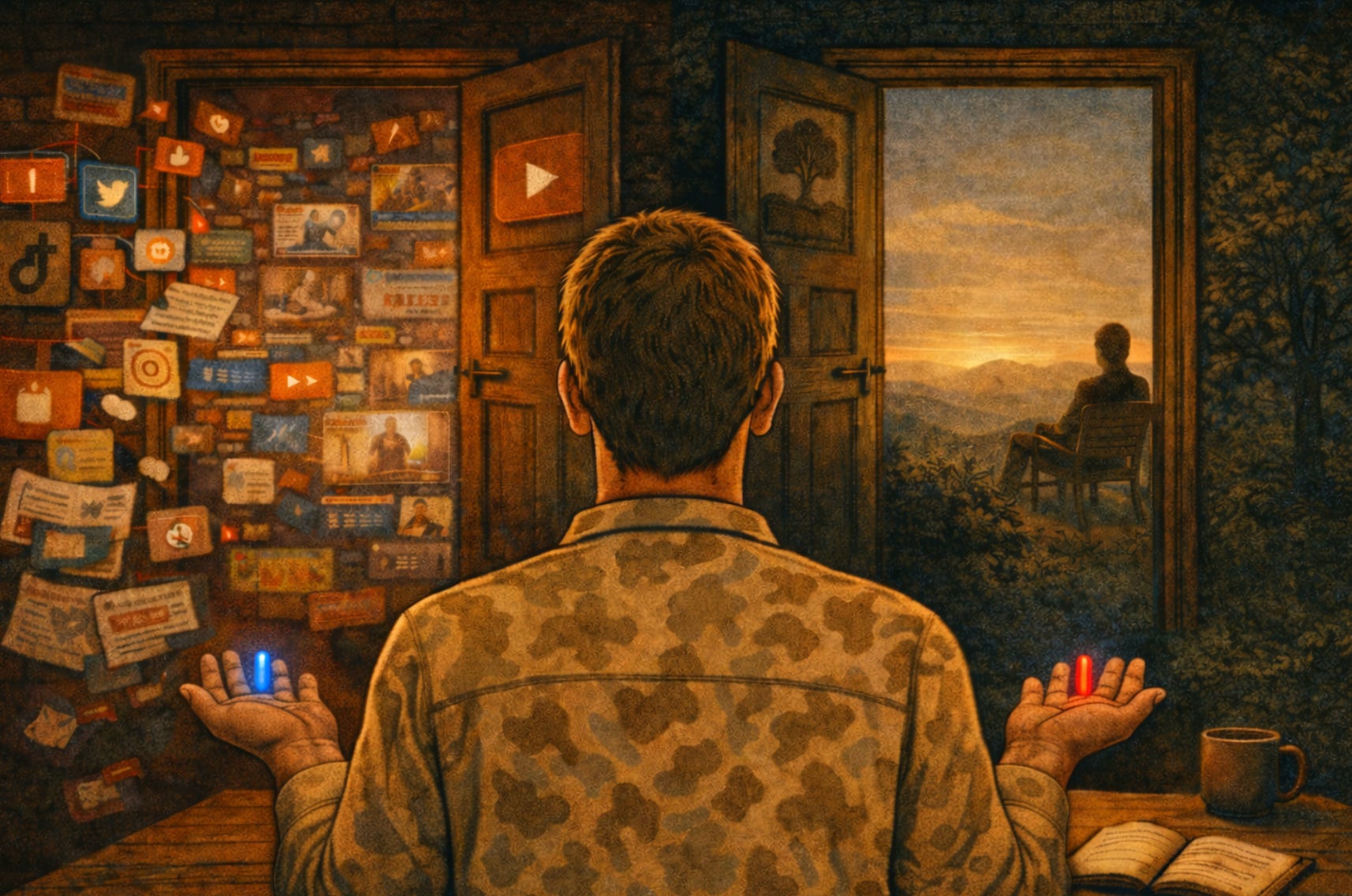
Image: Decision Time
---
Introduction
Don’t you feel it?
Sensationalist headlines and clickbait news. Addictive short form videos. Incessant pings, notifications, calls, red dots. 18 million apps competing for your attention.
This is the blue pill. The world we inhabit. We take it daily.
But why?
Well, first off everyone’s in this world so we are worried we miss out if we aren’t in it.
Second, we’ve normalised this world so we don’t question it. Grabbing your phone or opening your laptop to do intention A - only to do B, C or D - barely registers as a problem.
And last, but certainly not least, it feels good. Limitless optionality, endless entertainment, unlimited discovery, slick interfaces and strong social norms make this the casino to hang out in.
Our brains are not machines and they never were distraction free. But this era, the digital era, has stolen something precious from us - attention.
I’m sure you’ve heard this before but I think many fail to realise just how costly this is. See, losing your attention doesn’t just equate to an inability to focus on a task or ‘be present’.
Losing attention deprives you of something deeper - your agency to create a better life.
The Three Forms of Attention for a Better Life
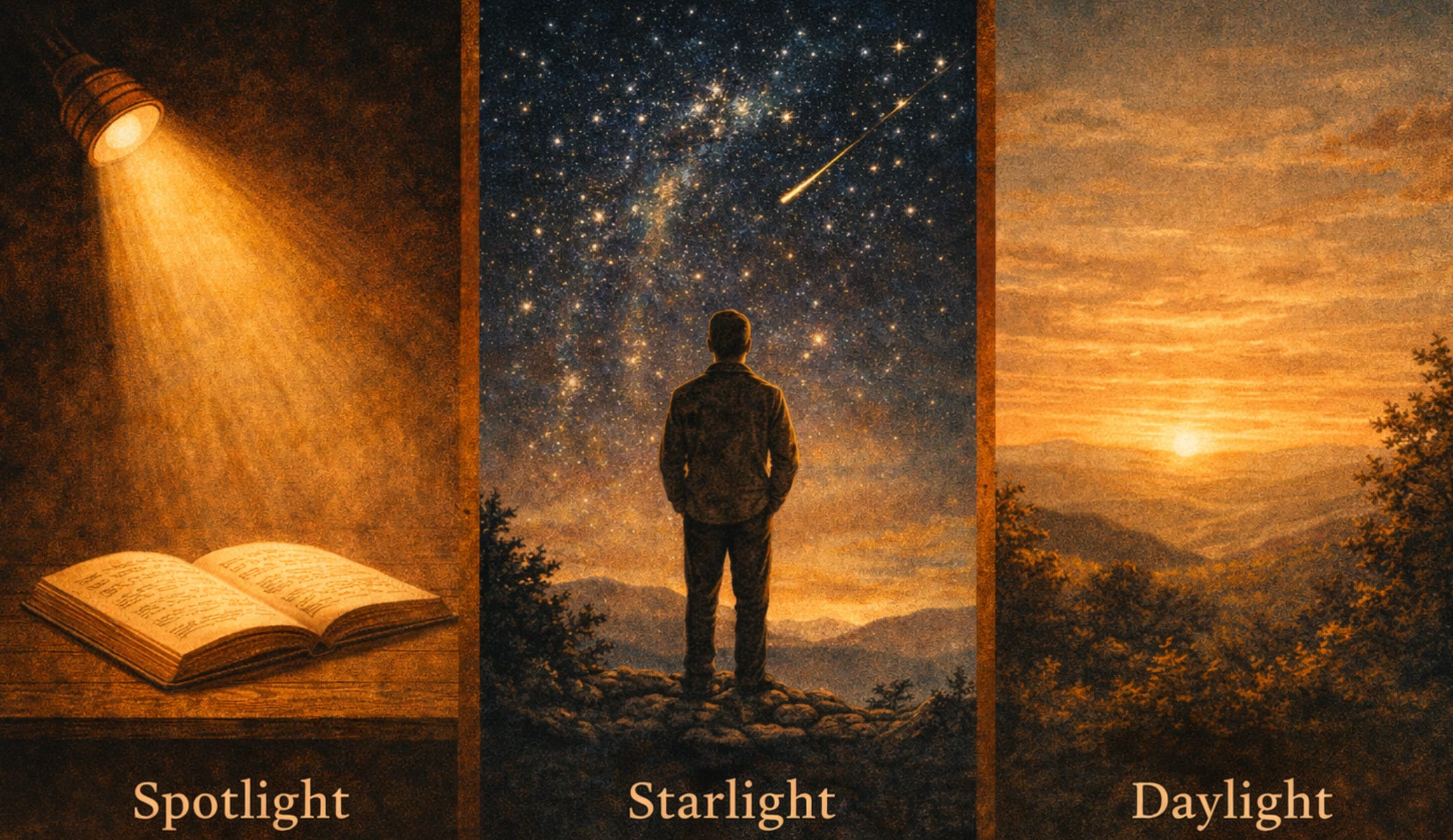
Image: Light Analogy Framework by Oxford Researcher James Williams
| Spotlight
A focused beam of light that allows us to concentrate on one thing at a time.
Eg: listening to a friend, writing, reading, cooking, playing an instrument.
| Starlight
The light generated from the stars. This is our ability to hold goals, values, and priorities over time and to determine what deserves our spotlight in the first place.
When starlight attention is degraded life becomes reactive.
Eg: building a career, being a good parent, pursuing meaningful work.
| Daylight
The light generated from the day that illuminates all. This form of attention is reflective and integrative. It underpins self-authorship, moral reasoning, and long-term wellbeing. It’s the capacity to step back, make sense of experience, and ask higher-order questions.
Without it, we remain productive but unexamined.
Eg: Is this the life I want? Are my goals still aligned with my values?
---
How it works
Together these attentional forms determine what we do and who we become. This isn’t woo-woo. This is science. Research in cognitive psychology and neuroscience proves sustained focus and unstructured mental time are prerequisites for depth, direction, and reflection.
Concentration allows the brain to stay with an idea long enough to develop depth.
Reflection requires periods without stimulation for experience to be integrated and evaluated.
When attention is constantly pulled outward by interruptions, notifications and novelty, the mind struggles to maintain goals over time or step back to assess whether those goals still make sense.
How We Got Here: Charting the Rise of Attention Fragmentation
“ A wealth of information creates a poverty of attention” - Nobel Laureate Herbert A. Simon.
A) Information Overload
Our attention has limits. Psychologist Mihaly Csikszentmihalyi estimated our attentional bandwidth at roughly 126 bits per second. A single conversation consumes nearly half of that.
Whilst this has remained fixed, the amount of information we consume has swelled.
We now consume roughly five times more information than in 1985. Aka 174 newspapers’ worth per day. A child scrolls through 1,000 posts in three hours.
The result is predictable. Sustained focus becomes very difficult.
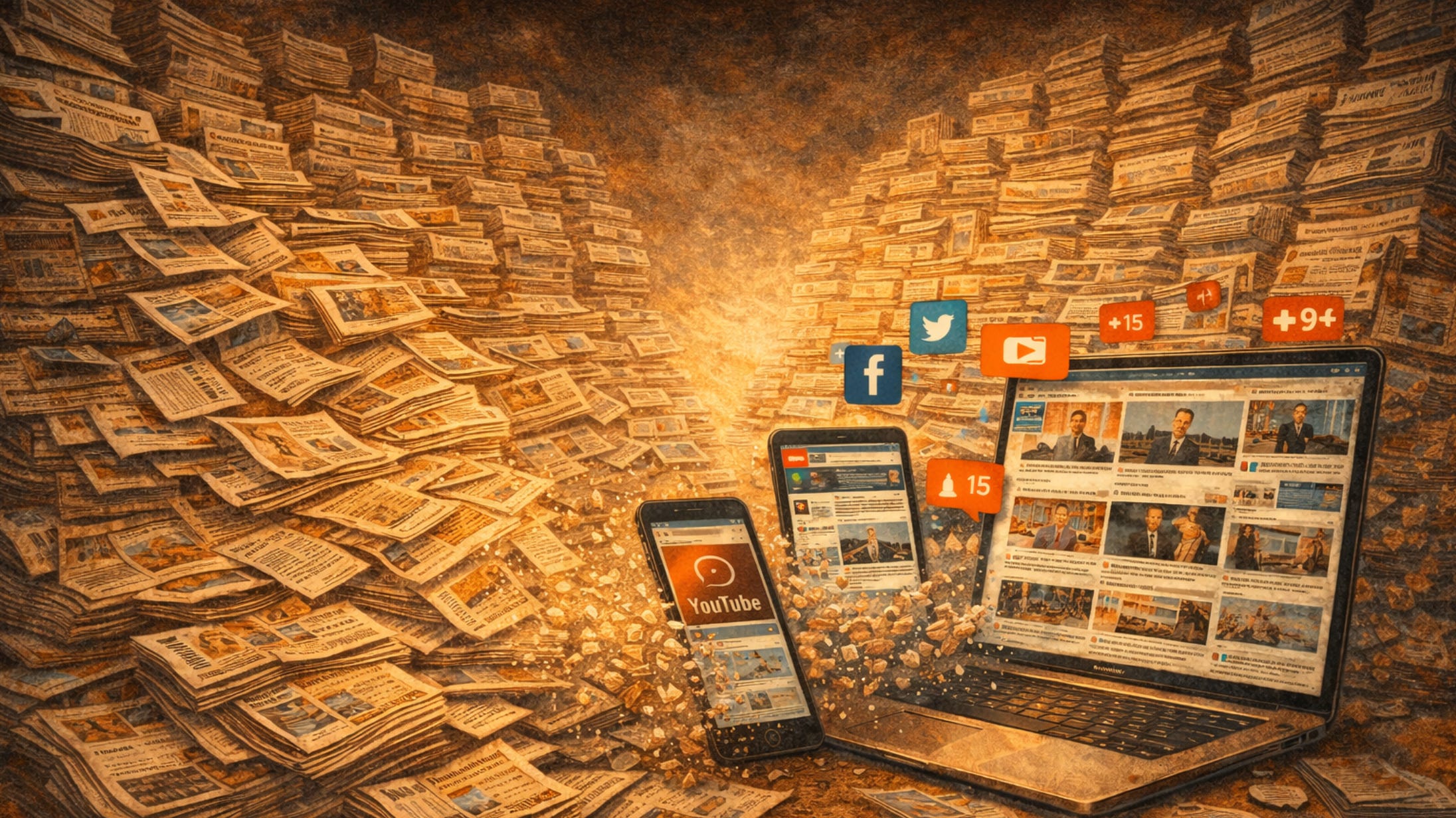
Image: Confronting The Daily Flood
---
B) The Loss of Mind-Wandering
We’ve become uncomfortable with doing nothing. Silence is constantly filled.
We check old photos in a queue. We search random facts in a lift. We refresh news in the bathroom.
We listen to podcasts on walks. We download films for flights - one of the last pockets of disconnection.
The result is the erosion of mind-wandering. Or, what cognitive psychologist Eric Godsey calls “the theft of our inner worlds”.
See, mind-wandering doesn’t mean zoning out or being lazy. It’s when the brain’s Default Mode Network becomes active - the system responsible for reflection, integration and creative insight. Many of our best ideas emerge here.
As Moshe Bar, author of Mindwandering notes “it is during the moments when we let our minds wander that we connect ideas, find meaning, and form a cohesive sense of self.”
When every gap is filled with content, we lose the ability to hear ourselves think.
---
C) End of Deep Reading and Rise of Skimming
Paper reading is down to 17 minutes a day, screen time is up to 5 hours a day.
That shift matters because, as Marshall McLuhan warned - the medium is the message.
And the digital medium often encourages speed, skimming, and surface-level engagement.
Take X (Twitter):
-> Character limits imply complex realities can be grasped instantly
-> Engagement metrics encourage judgement by popularity, not understanding
-> Endless feeds discourage staying with any one idea
We skim and so, we suffer.
Articles are reduced to headlines, videos cut into clips, books summarised into bullet points. Our brain becomes conditioned to crave speed and novelty. We become impatient with anything demanding.
Deep reading immerses us in someone else’s perspective. It slows us down and stretches our capacity to relate. When we skim, we fragment the narrative and, in doing so, lose the richness that invites empathy.
This is backed by 54 Meta(!) studies comparing reading comprehension on digital vs. non-digital reading. The finding? Comprehension was lower on screens - they labelled this phenomenon ‘screen inferiority‘.
----
D) Addictive Design Mechanics
Our ability to focus is also hijacked by design mechanics. More here but some key developments:
→ High stimulation design: bright colours, moving graphics, bite-sized mini videos
→ Sophisticated Algorithms: serving up hyper-personalised addictive content
→ Non-stop content: autoplay and bottomless feeds
→ Interruptive Cues: pings, badges, and real-time notifications
----
E) 'Overview’ Interface Design Remains Dominant
I want to listen to a song on YouTube. But that would just be too easy.
Before I can even finish typing, my eyes are shown Ukraine-Russia negotiations, another abject English cricket performance in Australia, Oasis splitting up rumours and film trailers.
But I wanted to listen to a song. A song - not the world.
But today’s digital (algorithmically fine-tuned) salesmen are ambitious. It’s not even a car dealer selling you insurance, heated seats and sat nav. It’s a car dealer selling you travel, geopolitical tragedy, sport, celebrity gossip and viral vapidness.
The display is the salesman’s most powerful tool, optimised to surface everything whether you asked for it or not.

Image: Salesman of the Month Hard at Work
----
F) Large Language Model Overuse
A recent Cornell University study split people into three groups: brain only, SEO-assisted, and LLM-assisted to explore the neural and behavioural effects of LLM-assisted essay writing.
The outcome isn’t groundbreaking. LLM-assisted users produced less original work, remembered less, and felt less ownership. What is more interesting is the longer term impact:
The formation and accrual of attentional debt - a slow erosion of our ability to generate, hold, and own ideas.
(Are we going to see a form of digital dementia anyone?)
The Impact
Quantified:
-> Median time on one activity for a computer screen is 47 seconds (Professor Gloria Mark)
-> Workers switch windows 1,200+ times/day (Harvard Business Review)
-> Americans are distracted every 3 minutes from a task at work on average (Professor Gloria Mark)
-> In one workplace A/B test, employees received emails and phone calls vs. not. The group that received emails and calls saw their IQ drop ten points - that’s double the cognitive impact of weed smoking.
----
Across the three attentional forms:
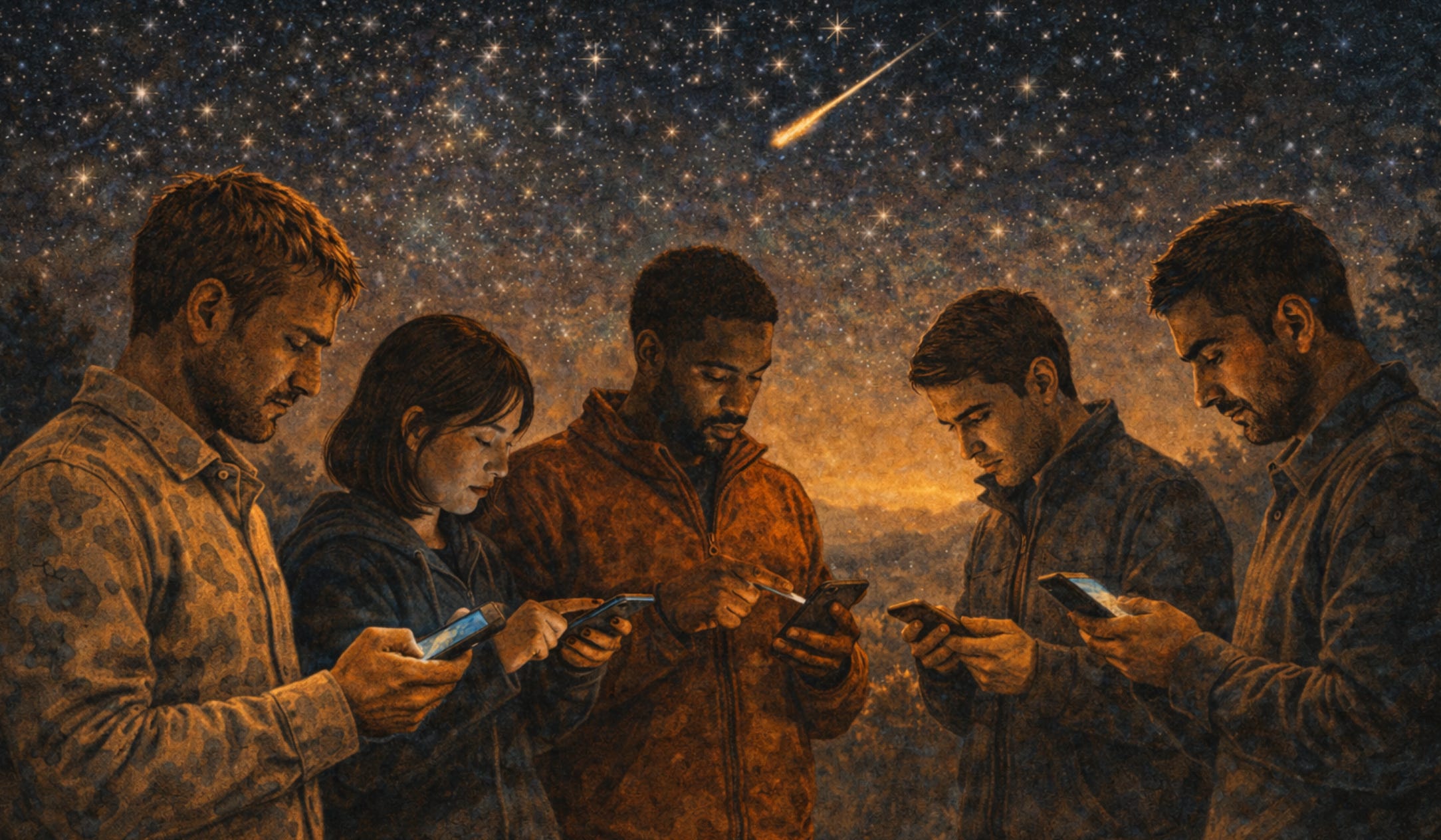
Image: Long-Term Intention and Insight Remain Buried as We Look Down, Not Up
Spotlight (focus): Constant novelty and dopamine cues trap us in shallow loops. We rarely stay with a task long enough to truly immerse ourselves in the activity.
Starlight (long term direction): Long-term intentions are buried beneath short-term noise. We stay busy but lose orientation.
Daylight (our reflective self-awareness): Without uninterrupted time to reflect, the mist never clears and you don’t integrate experience in a way that pushes forward who you are and what you are looking for.
The Antidote
One word. Four letters. _ _ _ _ F. L. O. W.
Flow is a really good feeling. It’s a deep state you enter when you’re fully immersed in an activity. Time dilates, thoughts dissipate and you feel creative, focused, and fulfilled.
85% of us recognise this state - whether it is playing sport, walking in nature, playing music, dancing, eating, intimacy, watching a film. And many feel this is the best of life.
This is the red pill. The Alternative.
Taking this pill isn’t easy. Especially now when the world we inhabit doesn’t yet preserve or augment focus. But it’s a pill worth pursuing.
Benefits include:
→ More fulfilment in your life by aligning personal insight with life decisions
→ More vivid days, stronger memories and more flow aka life’s highlight package
→ More presence in your days which feels better. I promise. You become intentional, not reactive.
Ultimately, you regain the space to hear yourself think - and from that space, you build a better life.

Image: Insights Emerge When You Take Time Off(line).
Building A Brighter Future : A New Path for Individuals
This path isn’t about rejecting technology. But until a brighter technological future exists, we need to learn how to flourish with what we have.
Distraction kills flow.
To tackle this, we need to:
#1 Reduce Exposure to Distraction
#2 Create Conditions for Flow
#3 Rebuild the Attention Muscle
----
#1 Reduce Exposure to Distraction
A) Constrain your Digital Ecosystem
You need hard limits, not just intentions.
Our brains have already been rewired to crave dopamine hits, to seek novelty and to ingest 5 second highly stimulation videos. Like breaking a cigarette or alcohol addiction, we need guardrails. According to the American Society of Training and Development, you are 65% more likely to complete a goal if you commit to someone, and 95% more likely if you have a specific accountability partner.
Tools like BePresent work because they remove choice. I cap my screen time at 90 minutes per day and block access to multiple apps during defined windows (e.g. 9pm-9am, 10am-midday, 5pm-7pm).
Go further and outsource access. I have a WhatsApp 30 minute limit - my friend has set a password I don’t know. You can also try financial pacts too. Set up fines if you break the limits.
B) Declutter Aggressively
On your phone, delete all unnecessary apps.
On your laptop, remove icons from the bottom of your Mac screen.
On your browser, group and hide tabs you’re not actively using.
Less visual noise = less cognitive drag (the invisible tax of processing unnecessary information) and less distraction opportunity.
C) Kill Dopamine Triggers at the Source
Switch your phone to grayscale.
Turn off all notifications.
Remove badges, banners, and lock-screen previews.
Make the compulsive urges less frequent and attractive.
D) Transfer daily plan to paper
I plan my day digitally but rewrite it on paper (< 5 minutes).
Writing your to do list down solidifies intention and removes extra distraction opportunities as you bounce between applications to find your to do list and what is up next.
E) Introduce screensaver distraction reminders
Change your phone background or screensaver to a prompt that restores presence. Even small moments of friction can interrupt subconscious distraction tendencies.
----
#2 Create Conditions for Flow
Flow doesn’t happen accidentally. You increase the probability of it through design.
A) Monotask & Timebox
The basics. Choose one activity. Commit fully. Define a clear start and end eg. 25-30 minutes focused on writing. The brain likes clear boundaries and relaxes when it knows there is an end point.
B) Motivate yourself
Curiosity releases dopamine, but in a way that sustains focus rather than fragments it.
Frame tasks as questions. Narrow the problem. Start with what genuinely interests you. Treat each session as an experiment, not an obligation.
When the brain wants to find something out, staying focused becomes easier.
C) Set Concrete Goals
Not “practice guitar” but “spend 20 minutes learning the first chords of All Along the Watchtower”.
D) Match Challenge to Skill
Flow lives between boredom and overwhelm. Choose a goal that stretches you. Too easy will lead to distraction. Too difficult will lead to avoidance.
E) Separate Spaces by Task
Working where you sleep blurs mental boundaries. Try libraries, quiet rooms, or designated areas for deep work. Let your environment cue your mind.
F) Clean the digital surface (if you are using digital for the task)
If the task is digital, simplify aggressively.
Hide toolbars. Use full-screen modes. Create a separate window with only the tabs relevant to the task at hand.
Simplifying what you see simplifies how you think.
G) Batch Communication
Designate specific windows for email, messaging, and admin. Outside those windows, close the tools entirely. Retrain your brain to communicate in blocks, not continuously.
----
#3 Rebuild the Attention Muscle
A) Practice Digital Fasts
Every time you re-enter the bottomless pit of social updates, emails, news, and videos, your brain stays “on” - tracking, reacting, half-preparing replies. It doesn’t get to rest.
Staying connected, informed and entertained is natural. But do it on your terms. Start small: phone-free half-days. Scale up: screen-free days. Let your brain rest from the always on madness. It isn’t healthy or natural for us as humans. Just reduce the noise and see how you feel.
B) Instill A Daily Routine of Phone-Free Mornings
Buy an analog alarm clock. Leave your phone off until you leave the house. Choosing a different, more quiet morning gives your mind the stillness it needs to orient and focus.
C) Work Offline by Default
Planes and trains often make us productive for a reason: no pings, no browsing, no rabbit holes. Try loading what you need and switching offline. When you instinctively reach for distraction, it leads nowhere and the urge passes.
D) Take Breaks without Stimulation
This one is tough but important.
Stop taking your phone to the loo. Stop watching videos in the spare ten minutes. Walk. Read. Stare out the window. This stillness resets attention, makes flow easier to reenter and reopens space for mind-wandering.
E) Use an app to monitor time
I use an app (Flow) to track time committed to a single activity. Seeing uninterrupted time build creates motivation to protect it.
F) Surf the urge
Your brain is a master at manufacturing urgency.
Ideas will surface during your day - a task, a friend to message, a topic to Google.
Delay any action by ten minutes. This delay allows the urge to subside naturally, as urges are often most intense at the beginning and lessen over time.
If the urge feels very strong, jot it down on paper.
Don’t let these sensations and thoughts be the excuse to stop mono-tasking. At a designated time (e.g., end of day), move any important notes to a digital medium if that helps for storage and actioning.
G) Build an identity and community
I have done this with Substack.
If my screentime was 8hrs and I was chasing TikTok virality, it would clash with my ‘identity’ and mission. You can do the same.
Signal your values publicly. Talk more about wanting focus, meaning, and better connection. Identity pacts are powerful - once others expect change from you, it becomes easier to sustain.
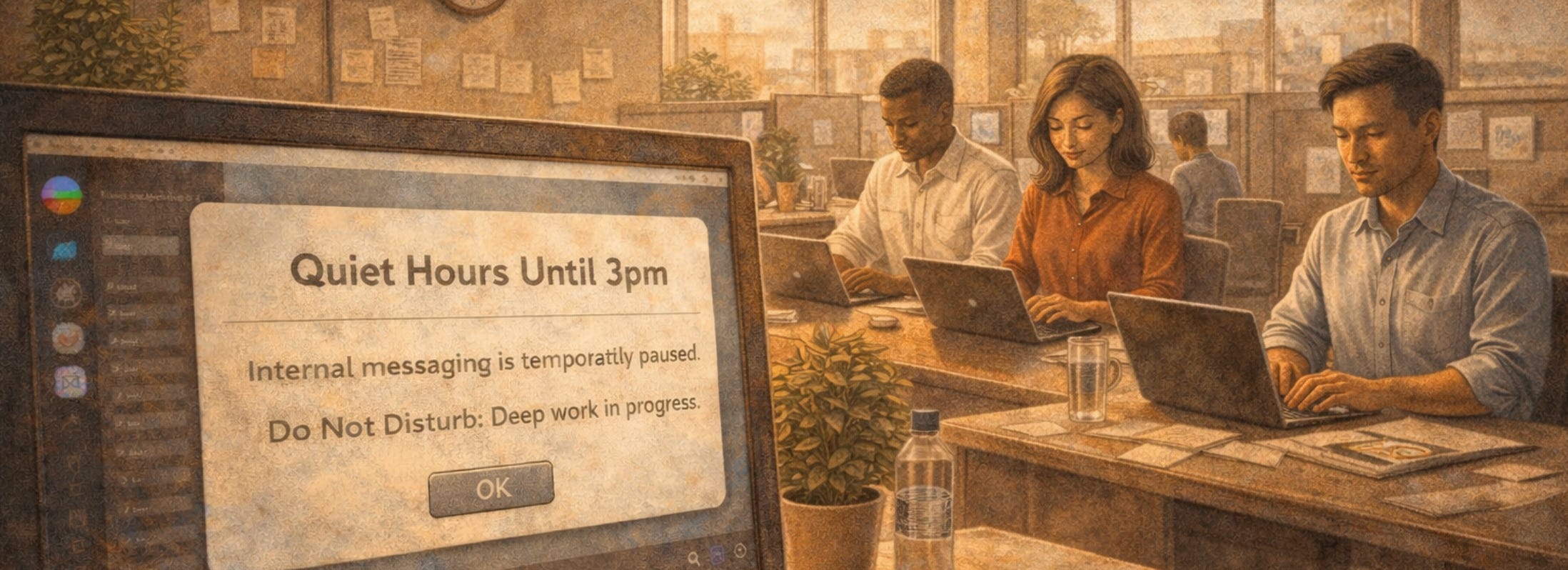
Image: Time To Reset Always On Norms Benefitting Absolutely No One
Building A Brighter Future : Business Guidance
Reclaiming focus isn’t just an individual challenge. It’s an organisational one. Workplace norms, tools, and environments need to protect attention.
A) Reset communication guidelines to promote deep work
Emails, Slack threads and Teams messages creep into every hour of the day, creating a constant drip of interruption. Set clear windows and expectations for asynchronous communication.
Experiment with daily “quiet hours” where internal messaging is paused - or even temporarily disabled. This may feel radical, but it shouldn’t. Deep work cannot survive constant availability.
B) Utilise office space to create focus zones
All office space should not be equal. You want the music, the chatter and the water cooler to preserve culture. But focus needs protection too. Carve out specific quiet areas. Introduce no-laptop tables. Make it easy and socially acceptable for employees to concentrate deeply when needed.
C) Remove tech distractions from in real life meetings
We’ve all done it. You are bored in a meeting so you turn to WhatsApp, email, the news. Remove the temptation. Where possible, keep laptops out of meetings. Use a single AI notetaker to capture notes so everyone else can be fully present. Better attention leads to better decisions.
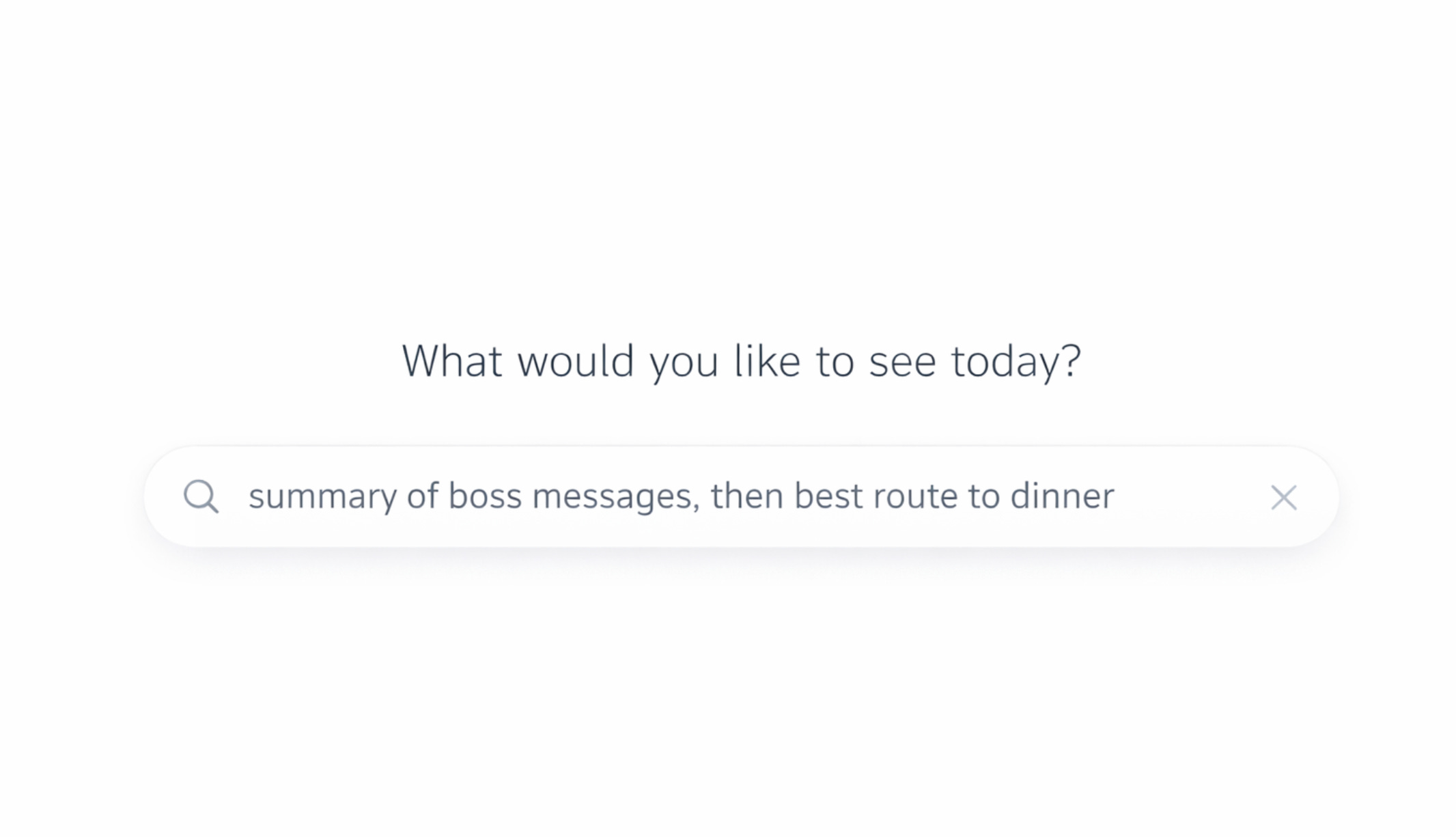
Image: Minimalist Modernism Is The Future Of Design. Promoting Focus & Flow. Feeling Light & Pleasurable To Interact With.
Building A Brighter Future : Future Design
Crowded screens, bottomless feeds, distractive design, information overload.
This model will die.
The future of technology is calm, deliberate, focused and slow. It respects our humanness and actively fosters focus.
Below are some initial design adjustments for a more humane digital future.
#1 From Information Overload → Information Caps
The volume of information we consume today exceeds what the human mind can process without fatigue or fragmentation.
Future displays are cleaner, quieter, and intentionally constrained. They limit what appears on screen and how much can be consumed over time. Attention is treated as finite - because it is.
#2 From Overloaded Overviews → To Purpose-Driven Screens
Dashboards today compete for attention - multiple signals, suggestions, and calls to action at once.
Future design builds each screen around a single, explicit purpose. One screen. One intent. Monotasking is encoded in design, not left to human discipline.
#3 From Context Limited Always On → To Nuanced Context-Aware Availability
‘Active now’ signals imply constant availability, creating pressure to respond and an unhealthy always on mentality.
Future design has a spectrum of status that reflects intent or context, not just device activity
Eg: ‘In deep work - only receiving messages from family and urgent matters’ , ‘On client site with deadline , please message after where possible’
#4 From Open Access → To Finding Task Flow
Today, every app, tab, and input is available at all times, regardless of intent. This constant optionality fractures attention and prevents flow.
Future systems infer what someone is trying to do and narrow the environment accordingly - surfacing what matters now and blocking the rest.
#5 From Passive Screen Time Logs → To Actionable and Robust Screen Time Analytics
Most tools report hours and averages, but offer little insight. Future analytics reveal where attention erodes, when addictive loops begin, and how focus can be restored. The goal isn’t less screen time — it’s healthier attention and more frequent states of flow.
The Future
So looking ahead, let’s be ambitious and brave. Let’s be disciplined. Let’s build a brighter future where we flourish in a digital era and where technology truly serves us.
The future is out there, it is bright and it starts with us and our decisions.
It’s time to take the red pill.
Time to focus more and get more done.
Time to find the space and time to connect the dots and derive the insights you need to build the life you want.
Time to give yourself permission to experience life fully.
Next
Making Sense of the Problem : Social Degradation in the Digital Age
If you enjoyed this, please subscribe or share. Thank you and have a great day 🙏
Sources
Johann Hari, Lost Connections
Johann Hari, Lost Focus
Jonathan Haidt, The Anxious Generation
Mihaly Csikszentmihalyi, Finding Flow: The Psychology Of Engagement With Everyday Life
Nir Eyal, Hooked