
Disconnecting to Discover
Experiment 1 : 72 Hours No Phone

To build a better future, you need to strip it back to basics first. To unearth where technology augments existence and where it doesn’t. To determine what will never be natural for us and what will but needs updating.
What better place to start then by removing the thing that people cling onto more tightly than their wallet?
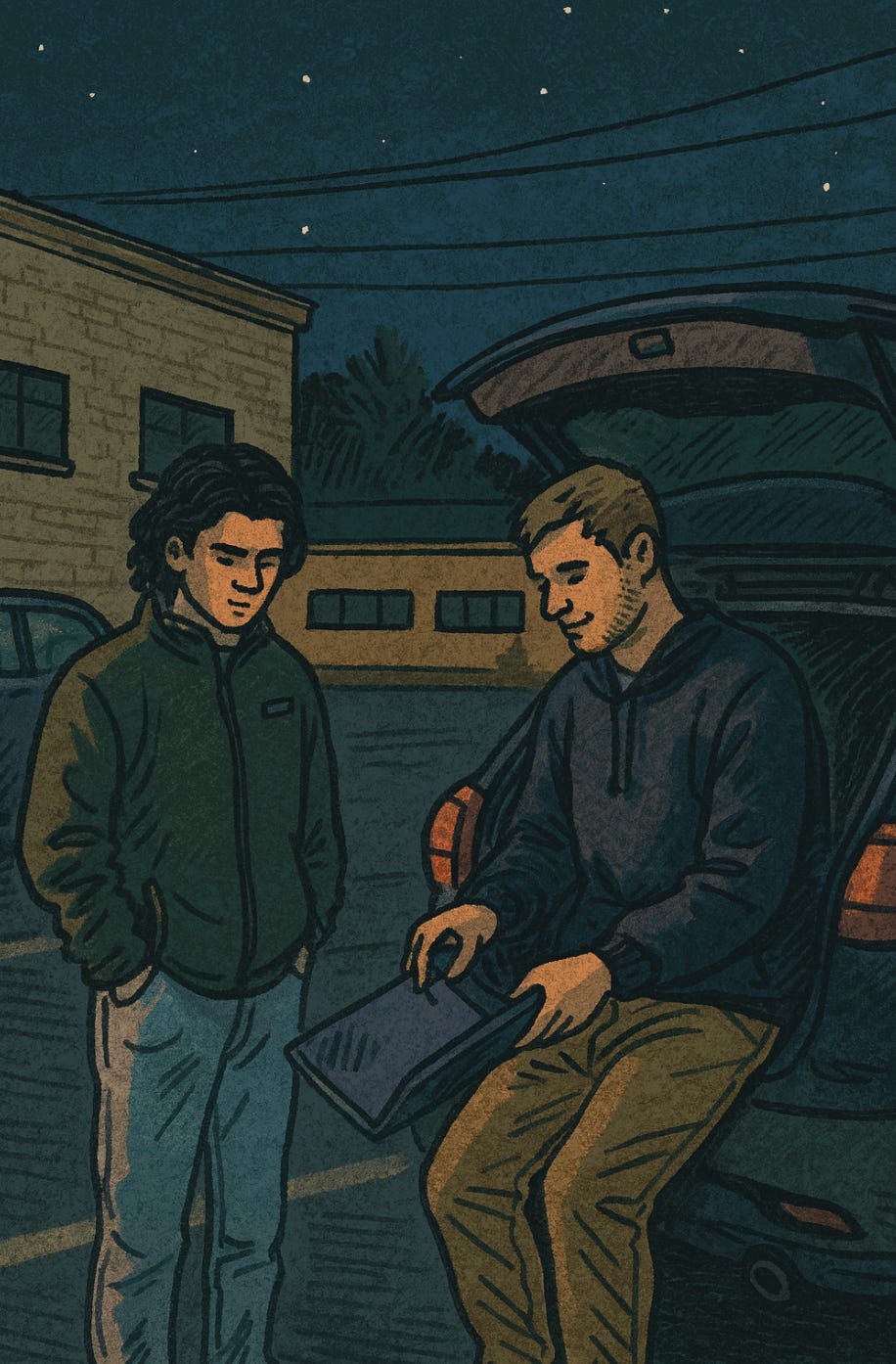
A friend and I switched off our phones and stored them away. We’re in a mega-parking lot outside a grocery store somewhere between Boston and Maine, heading to Acadia National Park.
The initial goal was small: three quiet days but my experience led me to write this.
Let’s start with the pains. Of which there are some of course.
Pains
#1 A deep feeling of guilt. Throughout the experience but particularly for the first 24hrs, there is a weird feeling of guilt. A sense that you are somehow being irresponsible or letting people down. You aren’t part of daily communication rhythms and being out of kilter feels a little jarring. That friction is social, not technical : you’re breaking an expectation loop.
#2 Basic co-ordination / communication. Two cars, a full parking lot and split routes. Without phones, we pushed logistics onto others. That’s real. It adds complexity and makes life harder for those around you. Without someone else having a phone, our groups would have been separated for the day. (a strong argument this is a positive - providing a sense of adventure we have lost…)
#3 admin gripes. The phone has dramatically helped us with basic admin tasks that are undeniably of value eg. transferring money instantaneously or accessing important information easily. At one point, I locked myself out of the Air BnB and didn’t have the code. A minor pain but indicative of the crucial role technology plays in easing daily administration.
#4 overcoming baseline addiction. Last and certainly not least. You have the impulse hand lunge for the phone when you have a spare minute between activities. You still search the jacket pocket when staring out the window on a car journey to feel it is still there. But I felt after 24hrs impulse intensity and frequency reduced.
Benefits
The most profound revelation for me was the shift in experience and memory.
#1 One uninterrupted, continuous motion shot
Our experience is punctured by the phone throughout the day. Whether it’s a spare 5 minutes, a trip to the loo or being in transit, they all provide ‘ideal’ moments to re-enter the portal. Remove those punctures and you’re no longer dialled into other lives that pull you from your own. Mini escapes don’t exist. You are where you are and you show up more in what you do and who you’re with. Fewer context switches reduce attentional residue too which makes sustained presence easier.
#2 Doing more, scrolling less
You only live once. And yet most will give 8 entire years of their life to social media. 8 precious years. Without a phone, “downtime” re-engineers itself. First, it’s less attractive - there’s no glowing rectangle calling your name. Second, it becomes planning time. You ask, what’s next? instead of what’s new?
#3 Bending time?!
In today’s world, time is quantised. It is not continuous. It is segmented. And much of that comes from our phones. Timestamps, notifications, calendar blocks. Even the phone background itself is dominated by a huge display of the TIME. Watches, clocks and time boxing all existed before but the phone reinforces the exactness of time: blocking 2.5 hours for work, I’ll eat at 1:15pm, home by 6pm.
Remove that anchor, and a new one emerges: the activity itself.
You start and finish based on feel, not digits. You measure the day by experience and the activity becomes the unit of time. And with that, it enables more control to plan, do and finish when it feels right. Whether that’s the duration of a walk or the specific time to go for a drink or head to bed. And all this does some pretty cool things. You are more likely to enter flow and when you do, you are in a state that expands perceived time vs. clock cues that can compress time.
#4 Rewiring thought patterns
This was genuinely pretty wild. A normal phone day offers constant access to billions of potential memory triggers:
England beat Serbia. 15 civilians killed in Lviv. Kanye West running for President. All ingested in <5 seconds. Alongside this immediacy is the power of the content. Strong emotional signals (very good or very bad) are what the algorithms loves.
Consider this, we have a lot of thoughts per day. Dr. Fred Luskin puts the low end at 6,000–12,000. Higher estimates go to 80,000. And what all these points of information bring with them are invitation to trigger memory patterns.
eg. Kanye → favourite album of his → could go to his concert → I wonder where that is → reach for the phone to search → new loop starts.
Now compare that to a continuous stream of lived experience. Fewer external triggers, just the environment. This brings with it, two really important and positive impacts:
Memories become more vivid. Memory consolidation thrives on emotionally consistent input. I can remember those three phoneless days more vividly than some entire weeks. Continuous narratives support hippocampal binding (the process by which the hippocampus links together different features of an experience—such as an object, its location, and its context—to form a cohesive episodic memory).
Mind wandering returns. Mind wandering is when your thoughts drift - not in a distracted way, but in a self-generated way. Without the flood, your brain roams free and goes in many directions - childhood memories, long-term priorities and time to realise what really matters. If the average day fills every void with digital noise, a day without it lets your mind breathe. (More on this in an upcoming article on attention fragmentation but this mental quiet is gold.)
#5 Cognitive Rest
No news really can be good news. We used to receive information in daily or weekly doses—slow enough to think, digest, reflect. Now we ingest thousands of stimuli an hour and call it “normal.”
It’s not normal. It’s a tax. Removing it lets your brain relax and recover. No more context-switching at an unnatural speed. When that stops, you feel genuinely rested. This also flows into sleep: quality and dream depth often improve when pre-sleep novelty and arousal drop.
#6 Better connection for friends and broader community
With friends - more presence cultivates better connection. Simple.
With community, it gets interesting. Without a phone, simple tasks like finding a coffee shop is slightly harder. So you talk to people. That’s a good thing. There’s been a real decline in micro-interactions - the small, friendly exchanges that stitch social fabric together. Remove the buffer and you get those back.
And these interactions are rich and different in their own way. They don’t require the same effort and they don’t share the same historical context as family and friend bonds. There’s a reason many love conversating with a hairdresser, a barista or a local council member. They offer a different type of connection that is great. Removing the phone brings more of this into your life.
LOOKING AHEAD : BUILDING A BETTER FUTURE
Here are some things I hope will be helpful for individuals right now and for builders of the future
Individuals
Just do it. It really isn’t bad. In fact, I hope I’ve shown it’s actually really good.
Find accountability. Use an accountability partner. Add stakes. £100 if you fail. After the initial discomfort, I’d wager you will say you felt better - and different.
Link it to social events. Hosting people for a weekend or dinner. Make people chuck their phones into a box. Make it part of the group experience.
Use workarounds. Tell people you will be away for a period of time. Use your laptop to make any urgent calls. Send emails. No phone doesn’t mean no tech.
Enjoy it. Don’t dread it. Be curious - see if you notice changes in mood, productivity, presence and experience.
Builders
This time also helped me build confidence in some assumptions that will shape the future I want to try and build.
Assumption #1 :
Most personal technological devices are intrinsically bad for us. They takes us away from the present and in doing so limit our experience and ability to connect.
Finding : Devices aren’t intrinsically bad. Their designs and the social norms surrounding them often are(more on this here) but they also played additive roles throughout that improved experience and connection:
Adding the vibe : we used a laptop and speaker one evening to listen to music whilst watching the sunset
Improved social connection using email : I emailed my parents and it felt like writing a letter. It was a richer form of communication - more intentional, deliberate and coherent. The medium shapes the message and instant messaging often dilutes connection.
Other technologies can keep us connected in healthier, more limited ways : I used email from my laptop as the link with others when I left the house a couple of times. Communication wasn’t severed - just clearly positioned: critical measures only, not to pass the time.
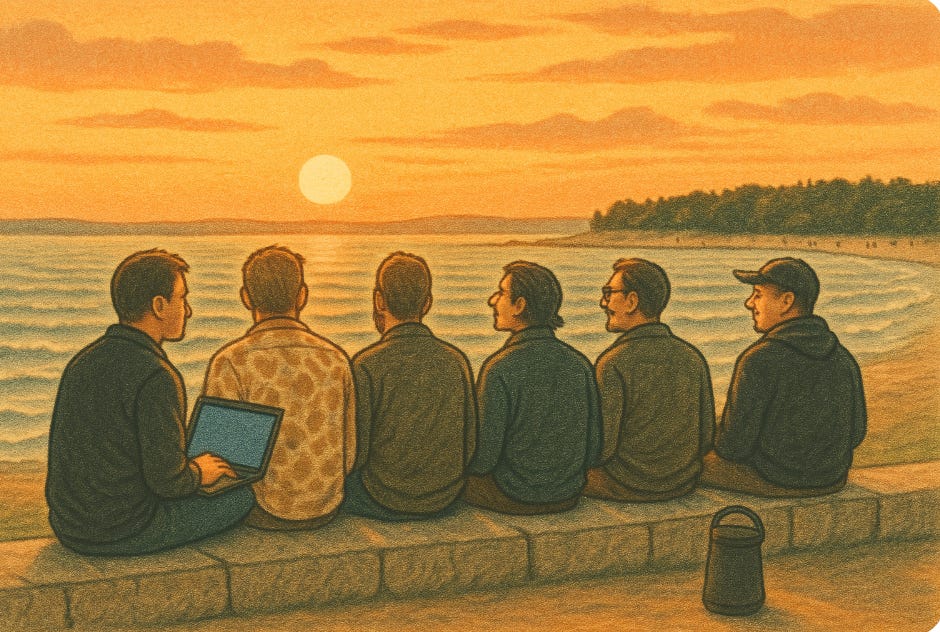
Sunset in Bar Harbour, Maine
Assumption#2 :
People are inherently addicted to devices. Building a future that overcomes dopamine addiction and compulsive checking is extremely difficult.
Finding : After a short ‘cold turkey’ - where you feel for the phone and think of the phone (so lame), you don’t miss it. Yes, I’m biased and self-aware. But I’m also addicted just like most people in some capacity. Translating these intangible benefits - presence, calm, connection - into compelling reasons to switch will be challenging. Still, there’s enough cultural fatigue and quiet frustration today that people want change. They know we’ve gone down a bad path.
Assumption #3: Going phoneless creates a divide. The haves and have nots operate very differently in how they experience the day and what they want to do.
Finding: the divide isn’t nearly as visible as you’d think. Those still “plugged in” barely notice; the phone is an individual habit, not a group activity. You, the one without it, simply move through a different mode of awareness.
Let’s build a brighter tech-human future together.
Harmony is closer than we think.

Acadia National Park
What’s next
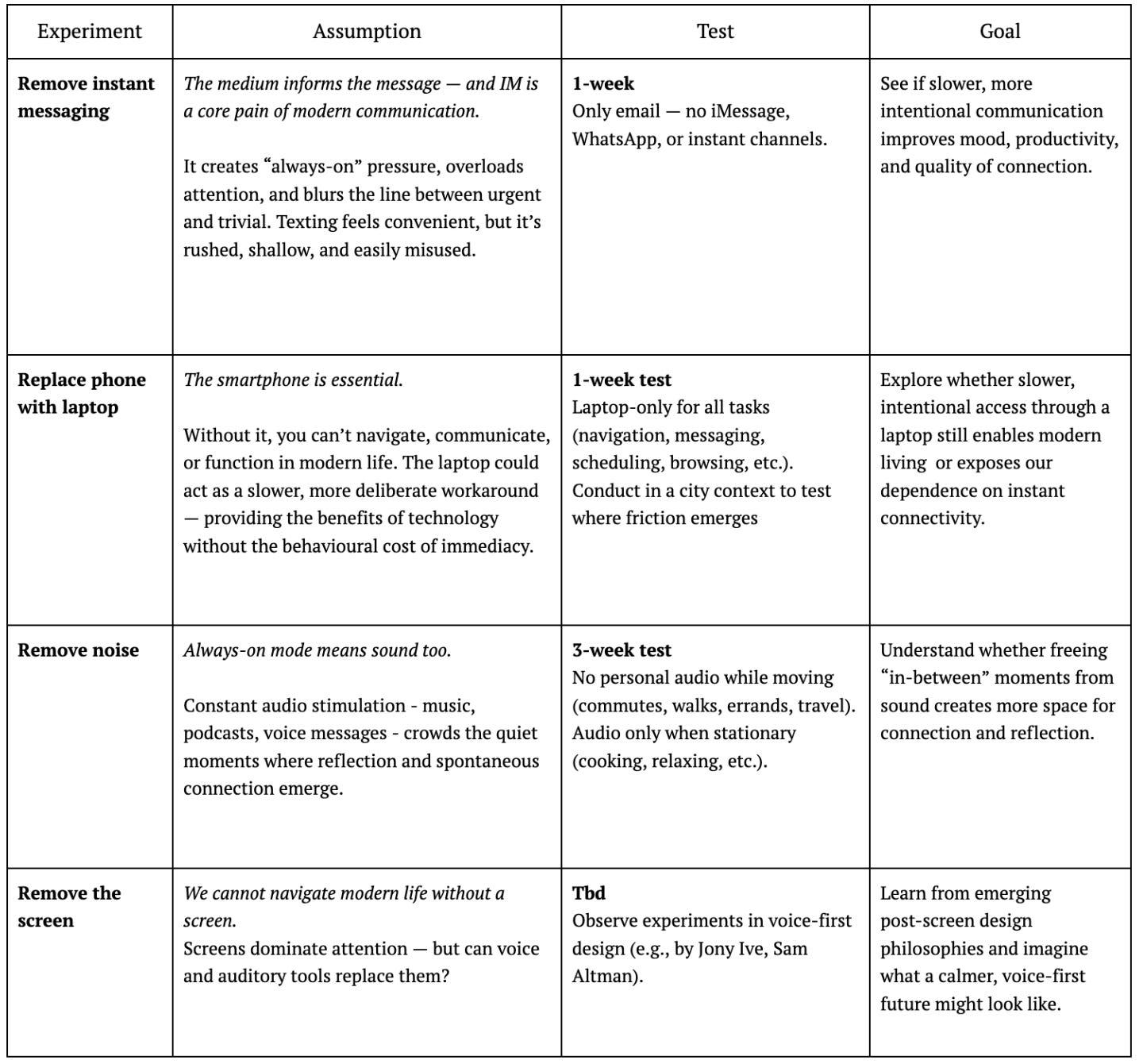
To zero in, I’ll focus upcoming experiments around the core ambition :
Restoring and deepening human connection in a digital world
My main area of exploration sits at the intersection of digital communication and connection - testing what truly supports meaningful interaction and what quietly undermines it.
A future batch of experiments will focus on building new solutions to improve digitally communication but right now, the focus is on changing our behaviours to see where tech adds value and where it doesn’t.
If you enjoyed this, please subscribe or share (links below)
Thank you and have a great day 🙏
Great read Jack! V interested in the concept of context switching and how this affects our immediate experience as well as mental health in the long term.
Fascinating read - section #4 particularly, I spend a lot of time thinking about memory triggers, and I had never thought about the framing of memory triggers as distraction points from vivid memory creation! Looking forward to seeing what your next round of experiments unveil…