
Confronting Our Digital Dependence
How digital addiction became the most accepted compulsion in the world

“The smartphone is the modern-day hypodermic needle, delivering digital dopamine 24/7”
Dr. Anna Lembke, Stanford Psychiatrist and author of Dopamine Addiction
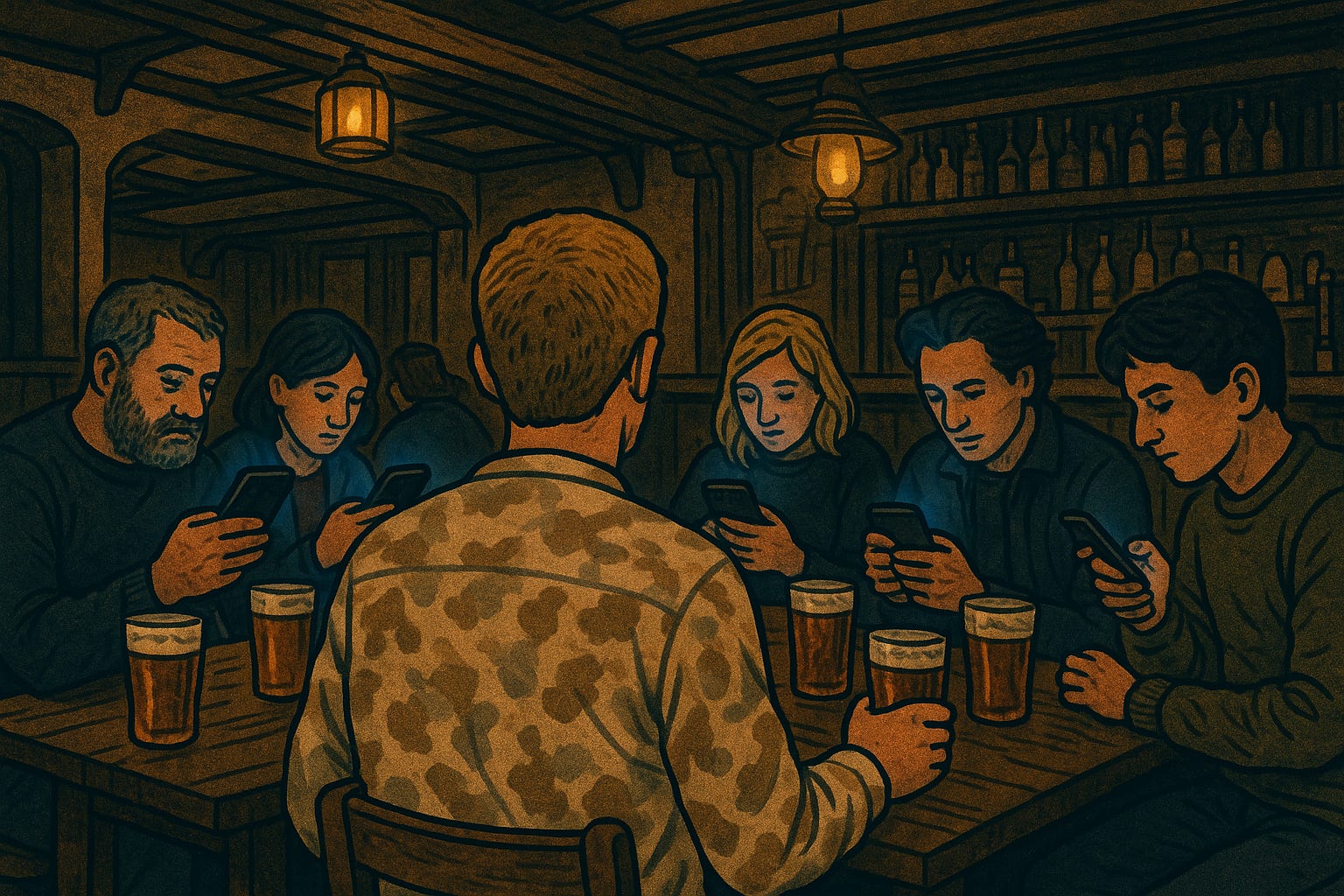
Image: A typical Friday night in 2025
Introduction
If we want to build a brighter future, we need to first understand today. And at the heart of today’s experience for literally everyone who’s ever used a smartphone, tablet or laptop is addiction. Digital addiction.
This story is about dopamine - a chemical messenger in the brain that’s released when you experience something pleasurable.
In the digital world, pleasurable things aren’t food or shelter. They’re novelty: a like, a match, a message or a notification. They feel important but rarely actually are. Each one gives us a tiny hit of dopamine. And tiny hits repeated often enough form dependence.
This dependence is governed by similar neurological loops as substance addiction:
reward → craving → withdrawal → repeat
Over time, our brains become conditioned to crave these hits, rewiring our reward system. And when dopamine becomes our default state? Ordinary life begins to feel dull by comparison.
It can lead to some comical outcomes. Next time you’re on a plane - observe digital behaviour. People do weird things for dopamine.
Last week I watched a guy try to log on to his mobile gym app with no signal (?!!). He typed in his login details, tried to log in and failed. 1 minute later he had another go. Seemingly satisfied with this experience, he closed the app, only to have a third attempt 5 minutes later…
If you ever watched The Social Dilemma is there anything that stood out?
The engineers, pioneers and designers ALL WANT OUT. Many send their own kids to no-tech Montessori schools. They all impose harsh limits for themselves and their families on digital consumption.
When the very architects of these systems refuse to use them - and shield their children from them - it isn’t just hypocrisy. It’s proof of harm.
How we got here : the model behind the addiction
Digital addiction isn’t an accident. There is a psychological engine behind it:
A) External triggers
A ping. A vibration. A red dot. “Someone liked your photo.” “You have a new message.”
These micro-interruptions act like little taps on the shoulder. They break whatever you’re doing and shift your focus.
Eventually, no external trigger is needed. The possibility of a reward is now enough. This is addiction in its purest form - when behaviour continues in the absence of a stimulus.
And the results are…lame.
It’s that feeling of opening your phone for no reason. Of your hand subconscious fumbling around to locate your phone in your pocket. Of tapping to refresh a website you’ve just refreshed. Or writing a search query to google to fill the void.
B) Action
You tap the alert, opening the app. This action is now semi-automatic, based on past rewards.
C) Variable Reward
You see a reward - a like, a reshare - or a disappointing absence of either. Sometimes there’s something, sometimes there isn’t. That “maybe” is what keeps us hooked.
This model traces back to psychologist B.F. Skinner, who discovered in the 1950s that pigeons would compulsively peck at a lever when rewards were given unpredictably.
This doctrine has now been adopted and championed as best practice by leading software designers worldwide.
That notification telling you it is a random person on your distant network’s birthday, followed by a notification that you have a relevant new message. That’s it right there. The variety in rewards creates an unpredictability that is addictive.
D) Investment
You post, comment, share and slowly build an identity to curate and maintain.
The more you invest, the more you return.
How we got here : the design augmenting the addiction
Interface designers also released a series of ‘innovative’ interface developments.
#1 Key releases to engage and re-engage
A) The Like Button (2009)
This was the moment social media stopped being social and became performative.
A public score for every thought, photo, or moment. The validation loop began.
B) Push Notifications (2011)
Before push notifications, you visited apps. After push notifications, apps visited you. This formed the basis to continually hook you back in and the beginning of “reactive living.”
C) Red Notification Badges (2015)
Red is evolutionarily coded as urgent: blood, danger, threat. Putting that colour on trivial updates created false emergencies that made our brains treat them like real ones.
D) Streaks (2015)
Streaks rewarded consistent daily usage. This created an artificial urgency to stay on top and keep up.
#2 Key releases to create a frictionless experience
Alongside mastering how to hook us in, businesses focused on keeping us in.
A) The News Feed (2006)
Originally, you manually searched for a page on a friend’s website. Then Facebook flipped the model and content came to you.
B) Retweets and Reshares (2010)
Sharing became effortless and you became more invested as an active contributro in forums.
C) “Always On” Signals (2011–2015)
Green dots. “Active now.” Read receipts. Blue ticks. These tiny indicators pressure made us stay responsive and plugged in. These developments changed norms and created a social obligation.
D) Bottomless Feeds & Autoplay (2013–2014)
The moment friction disappeared during digital sessions. Before: you had to choose another video. After: the next one chose you. Before: you scrolled to the bottom of a page. After: there was no bottom.
E) Hyper-Personalised Content (2012–Present)
Increasingly sophisticated algorithms began showing us increasingly compelling, relevant and emotional content to keep us locked in.
F) Reels, Shorts, and the Age of Tiny Dopamine (2016–Present)
Fast, bright, bite-size, emotionally charged content created a more addictive format.
The impact
I won’t labour the point. We all feel it. Dopamine-fuelled experiences leave us overstimulated, then drained.
A) Overstimulated and depleted
The chase means we check our phones every 6.5 minutes. We rarely turn them off - 42% of people never do.
Every check carries an expectation and when nothing appears (which is most of the time), the brain experiences a subtle crash.
B) The Boredom Crisis
When the brain normalises hyper-stimulation, the ordinary world can’t compete. Conversations feel slow. Books feel heavy. Walks feel empty. Silence feels awkward.
This is one of the quiet tragedies of the digital age: real life begins to register as “not enough.”
C) Usage & Preoccupation Costs
Hours lost are staggering. Eight years of your on av spent on social media. The length of primary school or the time it takes to become a surgeon. That entire thing is just spent staring at a device.
Screen time is only the visible part too - the deeper cost is preoccupation. The mental pull. Thinking about posting. Wondering about replies. Half-listening in conversations because you’re waiting for your phone to light up. Feeling the phantom buzz in your pocket.
There’s no perfect statistic for this yet, but one thing is clear: the mind remains online even when the hands are offline.
D) The Social Cost
Being “always on” means we’re rarely with the person in front of us. We’re half-here, half-there - split across digital spaces.
And it happens everywhere. I was at a talk last week where people from different countries told us about the history of their country in a series called “Flag Day”. 80% of the room were on their phones or laptops…
Two days later I’m having lunch with a group. 5 out of 6 are on phones. No one’s talking. Everyone’s just absorbed by their own highly addictive digital world.
We have to care more about this. We didn’t sign up for this. But we are living inside it.
So now the question becomes: How do we take our lives back?
What’s Next : Building A Brighter Future
Many major technologies follow a similar course. They are invented for a particular reason, begin with promise, solve real problems and improve our lives. As they scale and evolve over time, however, they often have unintended consequences. Our personal devices weren’t built to make us digitally dependent but the ecosystem built on top of them has.
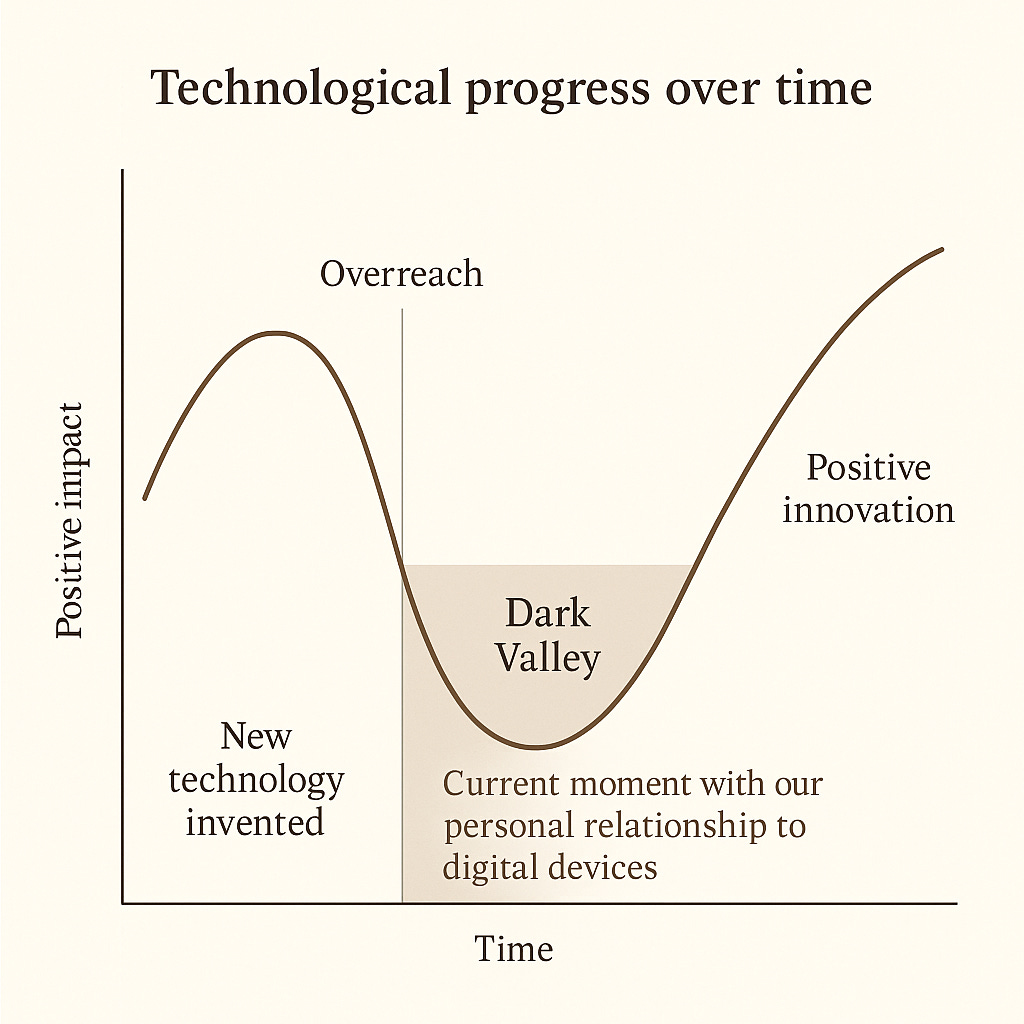
Image : in 2025 we find ourselves in the dark valley.
And yet, there is hope. The future isn’t science fiction. It’s already happening. People feel pissed off and powerless and they want change. We have some of the brightest minds in the world working on this exact topic (Jonny Ive and Sam Altman looking beyond the screen)
A new chapter is coming - and the winners of the next technological age will be the ones who put humanity first.
Building A Brighter Future : A New Path for Individuals
Let’s get to it. Rewiring our brains is no small feat. But with discipline and commitment - we can do it. After all, what good in life is easy?
#1 Remove external triggers
A) Tech-Free Zones
Charge your phone outside your bedroom. Don’t watch your laptop in bed. Create living spaces where your mind doesn’t subconsciously search for stimulation. Your environment shapes your behaviour more than your willpower ever will.
B) Mute notifications
Remove constant triggers so you have more agency and control on when you want to spend time in the ecosystem.
#2 Break the craving loop
A) Phone free mornings
Buy an analog alarm clock. Leave your phone off until you leave the house. Reclaim those mornings and start your day with intention. Checking your phone every ten minutes trains the brain to expect stimulation every ten minutes. Reclaiming the morning is a full pattern reset.
B) Dopamine Fasts
Anna Lembke, Stanford Professor and author of Dopamine Nation, recommends dopamine fasts as a first port of call when any client mentions anxiety, depression, or insomnia. Try one evening, no screens. Go for a walk, read a book. See a friend for a drink without taking your phone with you. Experience life.
#3 Find what works for you
A) Self-Audits
Reflect and act. What is draining you? YouTube rabbit holes. Instagram fomo. LinkedIn comparisons. When you see the emotional cost of a behaviour in plain sight, you stop treating it like something you must endure and start treating it like something you can change.
B) Delete or Limit
For the worst offenders, don’t just “use them less” - make them harder to reach. Delete apps that reliably make you feel worse. Set simple screen-time limits for specific apps so there’s a clear boundary, not just good intentions.
C) Trial and Error Mindset
There’s no universal method for breaking digital habits. Everyone’s triggers are different. Everyone’s patterns are different. Some things I’ve found useful:
Turn your phone off completely for periods of the day. When it’s fully off, there’s an extra step of having to turn it back on that prevents your compulsive urges from diving back in.
Don’t have your phone visible or ‘feelable’. If it’s on the desk you will reach for it. Weirdly for me, if it’s in my trouser pocket, I can feel its weight and it kind of pulls me back in. Putting it in my bag reduces that subconscious pull.
Make fun alternatives. If your not on your phone scrolling social media, you just gained 8 years of life back (wooo). Now spend the time wisely, commit to new activities (micro and macro) to fill the different spaces. Macro could be exercise, exploration, a personal passion project. Micro could be 5 minutes of reading, meditating, stretching, stepping outside or journalling.
#4 Accountability
I cannot overstate how massive this is.
We all need accountability. Try:
Price Pact with a friend eg. £10 if you exceed your phone screen time goal of <2hrs per day
Identity Pact: embrace an identity that supports your goal e.g. what this Substack does for me.
Effort Pact: find friction and make it an effort to stay hooked e.g. unplug the Wi-Fi to create friction at night.
Building A Brighter Future : Business Guidance
Most workplaces run on technology that is “always on,” yet never question the cost. Digital addiction doesn’t just harm individuals - it erodes focus, creativity, decision quality, and culture. Leaders can’t afford to ignore it.
#1 Launch a digital use initiative
Most teams never talk about digital habits, even though constant checking quietly drags down focus and energy.
You don’t need a huge program, just a simple reset that helps everyone understand the issue and agree on better norms.
Run short education sessions
Explain the basics: why notifications trigger impulsive checking, how the dopamine loop works and how compulsive use affects concentration, output and ability to connect with each other. Make it clear : less distraction → clearer thinking → better brains, better outcomes + a more connected group of people
#2 Redesign Collaboration - Fewer Screens in Moments That Don’t Need Them
Screens are essential for some tasks but distracting for others. Creative work, planning, coaching and problem-solving all get worse when everyone has a laptop open.
You can influence this and it’s low effort.
a) Identify meetings better done without laptops and make that the new norm: brainstorms, 1:1s, strategy sessions, feedback conversations.
b) Swap screens for analog tools : whiteboards, large paper pads, sticky notes, printed docs. It instantly changes the depth and quality of thinking.
c) Frame it lightly : “Let’s close laptops for this one - it’ll help us think better.” People feel the difference immediately.
#3 Create Tech Free Moments
Work socials often mimic the workday: phones out, half-present people, shallow conversations. Try small experiments:
a) Phone-free team lunches or coffees
b) An optional phone-free Friday afternoon
c) Offsites without devices on the table
In a world where people get 1000s of pings a day. Some enforced quiet can be a source of real relief.
Building A Brighter Future : Future Design
#1 From Gamification → To Functional, Non-Performative Design
Likes, emoji bursts, streaks and view counts quantify every interaction and turn communication into performance. These features reward external validation, not meaningful connection. A healthier future strips away unnecessary scoring and returns to simple, functional interaction.
#2 From ‘See Everything’ → To ‘See What Matters’
Most interfaces overload us with information because the default assumption is: more is good. But more is mentally expensive. A better design pattern begins with user intent.
A simple prompt:
“I’m here to reply.”
“I’m here to browse.”
“I’m here to plan.”
and the interface adjusts accordingly.
We don’t need all the information all the time.
We need the right information at the right moment.
#3 From Bottomless Feeds → To Friction by Design
Healthy technology builds in natural stopping points. A pause. A prompt. A moment to ask: “Do I want to continue?”. Friction is not a flaw.
#4 From Constant Availability → To Protected Time by Default
Today’s tools assume we are always reachable. Green dots, read receipts, active-now signals, and instant messaging norms. This creates a quiet pressure to respond. A healthier design future respects human rhythms. It builds in boundaries: modes that protect focus, delay messages, or batch notifications by default. Not as “Do Not Disturb hacks,” but as the natural state of the system.
So looking ahead, let’s be the brave ones. Whether you’re a business leader, a builder or someone trying to live with more intention, you have influence. Over norms at home, the culture at work or the products you create.
Harmony is closer than we think.
Next
📚 Making Sense of the Problem : Attention Fragmentation
If you enjoyed this, please subscribe or share (links below)
Thank you and have a great day 🙏
Key Sources
Jonathan Haidt, Anxious Generation
Nir Eyal, Hooked
Johann Hari, Lost Connection
Johann Hari, Lost Focus
Please comment with anything you’ve done that’s helped along the way too. Collective thinking & action is the best way to make progress
The world desperately needs more tech-free moments! Not only in the workplace, but in homes and schools as well. "Enforced quiet time" could be a real game changer in production as well as in enjoyment of the job at hand. At least, for now, technology has an OFF button. We should use it while we still can.